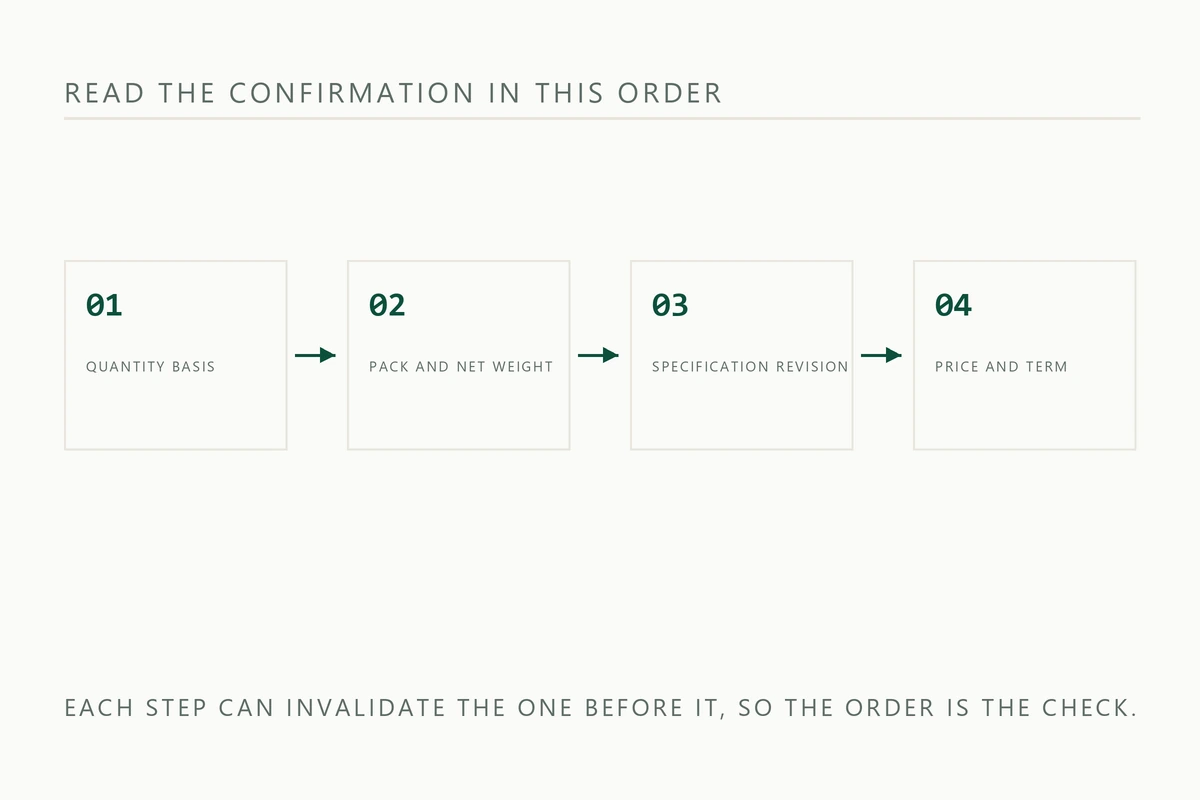
A toothpaste order confirmation is the supplier's own statement of what will be made, in what quantity, at what price and under which revision — not a copy of your purchase order. Before you release a deposit, read it in one order: quantity, pack and net weight, specification revision, then price and term. A confirmation that matches your order word for word has confirmed nothing.
An echo is not an agreement
Suppliers often return your own order text with a stamp on it. That looks like agreement and is worse than nothing: a document to rely on that contains no decision by the party you are relying on.
What separates the two is authorship. A confirmation written by the supplier differs in small ways — a line reworded, a unit restated, a variant name corrected. Those differences are the evidence that a person read it. Treat an exact echo as an open question.
The five lines to demand in the supplier's words
Ask for these as sentences, not as fields copied from your template:
- Quantity basis. A unit, not a bare number, and whether inner cartons count separately.
- Pack declaration. Units per carton, declared net content per unit, and the gross weight of a carton as packed.
- Specification reference. The revision identifier and its date, not a description of the product.
- Price basis. The unit the price is quoted in, and what that price includes or leaves out.
- Delivery term. The named term, the named place, and the point where risk and cost pass.
A confirmation missing any of the five is short of a commitment, and the gap gets filled later by whoever has the better file.
Quantity first, because it re-prices everything after it
Every other line is a multiple of the quantity. A confirmation reading "10,000 cartons" against your order for 10,000 tubes is not a slip you can tidy up later: price, weight and container fill are all downstream of it.
Tubes, cartons, displays and pallets are four different units, and one that mixes them has not stated a quantity at all.
Three multiplications that catch most errors
Confirmation lines can be checked against each other without knowing anything about toothpaste. The figures are an assumed example, not a quotation:
| Check | Assumed figures | What a mismatch tells you |
|---|---|---|
| Units to cartons | 12,000 tubes ÷ 48 per carton = 250 cartons | The carton count and the pack statement disagree with each other |
| Units to paste weight | 12,000 × 100 g = 1,200 kg net | The declared net weight and the declared net content disagree |
| Units to money | 12,000 × unit price = order value | The price was quoted per carton, but the total was written for tubes |
Each row multiplies or divides by a number the confirmation states. When 250 cartons appears as 300, one of the two lines is wrong and you do not yet know which. And a packed weight that implies less tare than a full carton can carry is a net figure wearing the wrong label.
The third check costs money quietly: a price written per carton and a total written for tubes differ by the pack count, and the gap survives every review that does not multiply.
Silence is not agreement
The lines a confirmation leaves out are the ones you argue about later, because nothing in the file contradicts either side. Artwork revision, fill tolerance, who approves a substitute cap, what the deposit releases — none of these appear unless someone put them there.
One sentence covers it: items not stated are not agreed. That does not make a supplier promise more; it makes the silence visible while you can still price it.
Three questions buyers ask
Is a proforma invoice the same document?
Often one page does both jobs, and the title is the least useful test. What matters is whether it states what will be made, not whether it is headed confirmation or proforma. If it carries payment instructions but no specification reference, you are being asked to pay before anything has been described.
The confirmation arrived as a chat message. Is that enough?
It records the agreement; it files badly. Ask for the same text on a document you can attach to the purchase order, and keep the message. One copy that cannot be edited later without a trace is what you need.
My supplier changed a line I never changed. Do I accept it?
Not silently, and not before the deposit: reply on that line, in writing. Accepting by silence is how a specification moves, and months later it reads as your instruction. If the change contradicts your order, the two documents disagree, and the resolution order for conflicting documents decides which one governs.
What to send with the next purchase order
Send the confirmation you want back, with the five lines named and the three multiplications run on your own figures. Ask the supplier to return it with any line they cannot meet marked rather than deleted: a marked line is a negotiation, a deleted line is a surprise at the dock.
The deposit belongs to the payment milestone schedule, and the point where a missing line turns into a release decision is the missing record question. Start from the NASHUDA toothpaste series, or send your requirements with the destination market, the SKU, the pack size and the revision you want confirmed.