
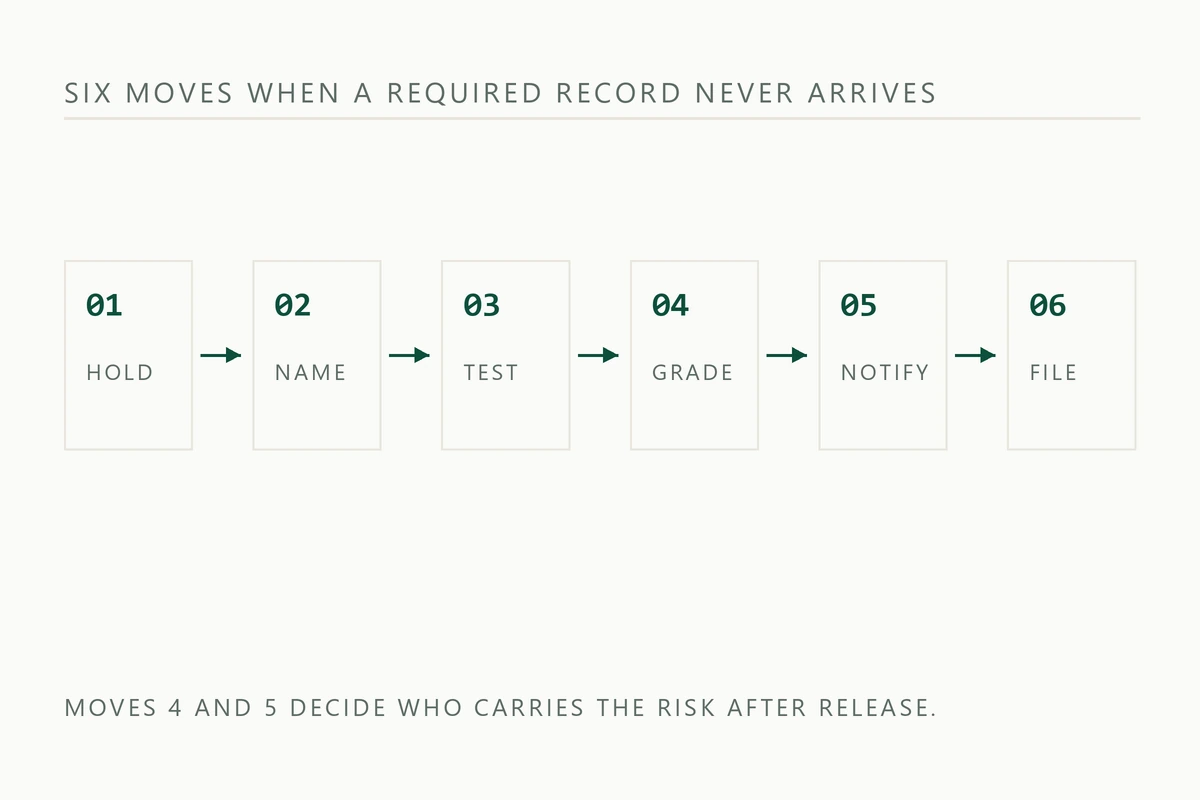
One record is missing, the goods are finished and the container is booked. The reflex is to hold everything until the paper arrives, and sometimes that reflex is right. It is not right by default. Six moves settle it: hold the goods, name the decision the record supports, test whether the fact can be had another way, grade the release, notify in writing, file the gap with a reopen trigger.
Hold the cartons while they are still reachable
A hold costs storage and a few days. A wrong release costs goods you cannot defend, and it costs them once the batch is no longer in front of you. So hold first and argue later, but write the hold down: which carton range is stopped, where it stands, who may lift it, and the date it expires.
An unwritten hold is lifted by whoever loads the truck, and a hold with no expiry becomes the state of the order.
Name the decision the record was meant to support
Records are requested for three reasons, and only one usually justifies a delay.
- A decision about the goods: whether this batch meets the specification — a composition, a measured property, a printed code.
- A decision about the transaction: whether to pay, accept or claim.
- A decision about the file: evidencing the order later, to a customer, an inspector or your own warehouse.
The third rarely justifies holding stock, because it can be closed after the goods move. The first usually does: the fact it carries is about this batch and cannot be rebuilt later.
Test whether the fact can be established another way
An absent record is not an absent fact, and buyers conflate the two. Three routes can produce the fact without the document:
- Direct observation on the goods: a batch code on the case, a seal, a date code, a case count you verify at the dock.
- A second issuer: the laboratory that ran the test, the printer that ran the label, the forwarder that signed the dock note.
- A later measurement: a retained sample re-tested, or a check run on arrival.
If any route works, you no longer have a release problem. You have a filing problem, and a dated note settles it.
Grade the release: four answers, not two
Release and hold are the ends of a range, not the only options:
| Grade | When it fits | What you sign | What you keep |
|---|---|---|---|
| Release as normal | The record was for filing, or the fact is established directly | The usual acceptance | A dated note of the substitute evidence |
| Release on condition | The fact is probable, or a defect would be detectable later | A conditional acceptance naming the item and a date | The condition, the date, the remedy if it fails |
| Hold in place | The fact is a property you cannot test after the goods leave | A hold notice with a decision date | The date you will decide with or without the record |
| Refuse | The fact is one you cannot accept without at all | A rejection quoting the requirement | The requirement text and the date it was first asked for |
Most real cases are the second row, and most buyers skip it because a conditional acceptance sounds like weakness. It is the only grade that prices the risk, naming what you accept and what happens if the record never comes.
Notify in writing before the goods move
One message, five lines: the missing item by name and revision, the decision it blocks, what you accepted in its place, the date you need it, and what you will do on that date. Send it to a named person, not the company, and keep the reply or the silence, because silence in a file reads as agreement later.
File the gap and set the trigger to reopen
The file needs the record you asked for, the date you first asked, who was asked, what you substituted, who signed the release, and what the deadline produced: the shape of the hold notice, deliberately, so one page answers both questions.
The last line changes next year. If the same record is missing twice, the requirement is not in your order documents, so fix the purchase order rather than the shipment — a repeated gap is a drafting problem wearing a logistics costume.
Three questions buyers ask
The goods are already on the water. Is there still a decision to make?
The release decision was made by default when the container left, so what remains is a receipt problem. Do the physical checks you can on arrival and record that the item was noted as missing before loading — which is what the receiving check is for.
Can I hold the balance payment until the record arrives?
Payment attaches to a milestone, not a document, so read the acceptance clause before withholding anything. If the record was never a milestone, withholding against it breaches your own terms; the payment milestone question is which event releases which instalment.
Is an emailed photograph of the document enough?
It establishes that a record exists, not that its content is final, signed or the revision in force. Treat it as second-hand evidence and get the issuer's own file. If the photograph and the file disagree, the resolution order for conflicting documents applies.
What to send before the next order
Send the factory the list of records your release actually depends on, marked by the decision each supports, and say which of them a direct check can substitute. That list beats a longer request: naming twenty documents tells a supplier which ones you will not miss.
Start from the NASHUDA toothpaste series or the Orbit & White range, and send your requirements with the destination market, the SKU and pack size, and the records your own release depends on.