
By the time the container is opened, most of what the order will be judged on is already decided. The delivery receipt is the exception: before you sign it, the carrier is still at the door, the cartons are still countable, and a crushed pallet is still a pallet rather than a photograph in an email.
This guide covers the receiving side of a toothpaste order: what to count, what to open, what to write on the carrier's document, and what a claim file needs before it is worth sending.
1. Sign after you count, not before
Unloading is where orders get lost: the driver needs a signature to leave, the warehouse wants the floor clear, and the count is easy to postpone. Reverse the order. Counting cartons against the packing list takes minutes while the pallets are still wrapped and identifiable, and far longer afterwards.
Three things belong before the driver leaves: a carton count, a look along the pallets and outer cartons for crush or water, and a written note on the carrier's document if anything differs. A signature with no note reads, downstream, as a clean delivery.
2. What the dock can settle, and what it cannot
A receiving check is not a product inspection. It answers a narrower question: is this the shipment we bought, in the condition the carrier was engaged to deliver?
Answerable at the dock:
- Carton count against the packing list, per SKU.
- Outer carton and pallet condition: crush, split seams, water staining, overhang.
- Whether the marks and lot code on each carton are legible and match the documents.
- Whether sampled tubes and caps are intact, and the retail carton matches your approved artwork revision.
Not answerable at the dock:
- Declared net content against the fill on the line.
- Seal performance after weeks in a supply chain.
- Flavour and odour, which a cold warehouse will not reveal.
- Whether this lot's batch record is the one you were given.
Everything on the second list needs a document or a later comparison.
3. Five steps, and what each one leaves behind
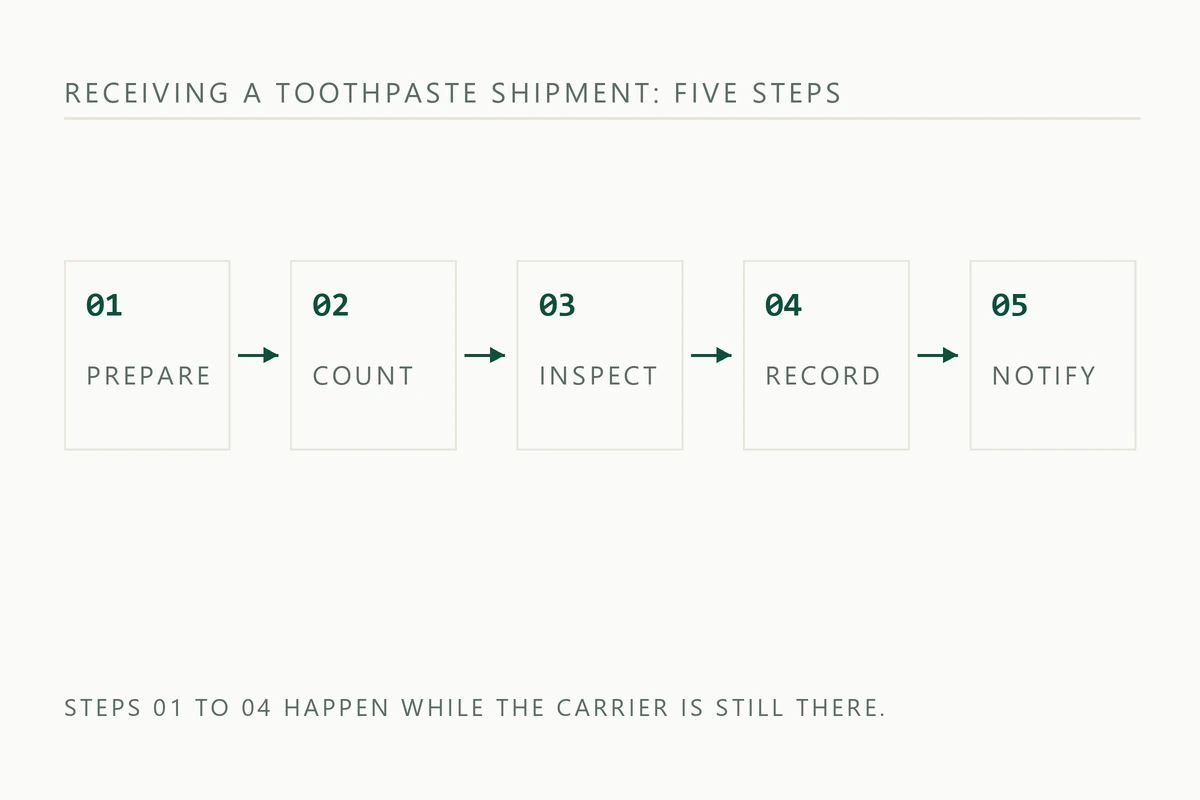
Each step exists to produce one file, so a disagreement later has something behind it:
- Prepare. Before the truck arrives, put the packing list, carton specification and approved artwork revision in one place. A team that has to search for the reference accepts whatever arrives.
- Count. Count cartons per SKU before unloading and reconcile the total against the packing list. Short cartons and short units inside full cartons are different problems.
- Inspect. Open a stated number of cartons from across the pallets, not only the top layer, and check tube, cap, retail carton and lot code. Note which cartons you opened.
- Record. Write the finding on the carrier's document before signing, photograph pallet, carton mark and affected unit together, and keep one affected unit as it arrived.
- Notify. Send the supplier notice and the carrier notice separately; they are different claims with different evidence.
Steps 01 to 04 happen while the carrier is still there. Step 05 goes out the same day: the window belongs to the carrier's terms and your contract.
4. The receiving sheet that makes a claim usable
Claims are rarely rejected on merit; they are rejected because the record states a conclusion instead of an observation. "Cartons crushed" is a conclusion. "Pallets 3 and 4, left face crushed, tubes deformed in two opened cartons, photographs A3 to A6" is an observation, and it survives being forwarded.
One row per affected carton, six fields:
| Field | What to write | Why it decides the outcome |
|---|---|---|
| Carton ID | The mark on the carton, copied exactly | Gives the supplier a unit to find |
| Count | Cartons received against cartons listed | Separates a shipping error from a short pack |
| Condition | Position and extent, not an adjective | Lets the cause be assessed without a visit |
| Lot code | From the carton and an opened tube | Ties the claim to one batch record |
| Photographs | Reference numbers, taken before anything moves | The evidence that survives repacking |
| Disposition | Held, released or quarantined | Shows the goods were held, not sold |
Send the sheet with the packing list, the annotated delivery document and the photographs, and state what you want: replacement, credit, or an inspection. A claim that asks for nothing is answered slowly.
5. Where the paste stops being checkable
A receiving check cannot establish conformance to the approved sample. Keep one sealed unit from the delivery, note the carton it came from, and run the comparison later under the conditions of the original approval; our guide to approved sample versus production batch sets out the fields.
Two questions belong to the supplier rather than the dock: whether the lot code on the carton appears in the batch record for this order, and what tolerance applies to the fill you ordered. Ask for both in writing before the first delivery.
6. What to send before the first delivery
Three documents make receiving faster: the packing list, the carton specification with the marks you expect on the outer carton, and the artwork revision the cartons should match. Send them with the order, and say which count — cartons or units — you will check at the door.
If the shipment is still ahead of you, the checks that belong before it leaves the factory are in our pre-shipment inspection checklist, which starts from the carton specification. Receiving catches what those steps missed.
Tell us your destination market, the SKUs and the carton marks your receiver expects, and we will confirm what the range can supply against the current batch record — including the fields we cannot fill yet. Start from the NASHUDA toothpaste series or the Cotelg series.
Send your receiving requirements to our team — market, SKUs and the carton marks you need printed.