Every importer who has built a range on one factory eventually asks what happens if it cannot deliver. The common answer — find a second supplier and split the order between the two — is the move most likely to leave you with two untested suppliers instead of one tested supplier. A second source is not a share of volume but a qualification file you keep current.
1. A second source is a file, not a share of volume
A backup becomes real when it could make your product to your brief, on the components you have already approved, for the market you actually sell into. Each of those is either documented or it is an assumption.
The mistake is treating "we have a second supplier" as a relationship. A relationship does not transfer: an account manager who answers quickly is not a specification, and a catalogue page is not an approved sample. What transfers is a file — the brief version, the retained sample, the documents and their dates. This page ranks no factory.
2. The volume trap: two half orders test nothing
Take an assumed requirement of 20,000 units of one SKU, split evenly. Each supplier makes 10,000, pays its own setup, and runs a first batch half the size of the order you will place. The figures illustrate a point, not anyone's minimum.
Two costs follow. The fixed work gets done twice — two setups, two artwork approvals, two first-batch conversations, two document sets. Neither run is at your real size either: a factory behaves differently at 10,000 units than at 20,000.
So do not manufacture volume to create a test. Qualify the backup on documents and samples, and let the trial be the first order it genuinely wins — a new SKU, a market the incumbent cannot serve, or a peak you cannot cover alone.
3. The five stages, and what each one has to settle
The five stages run in this order because each supplies the reference the next is judged against.
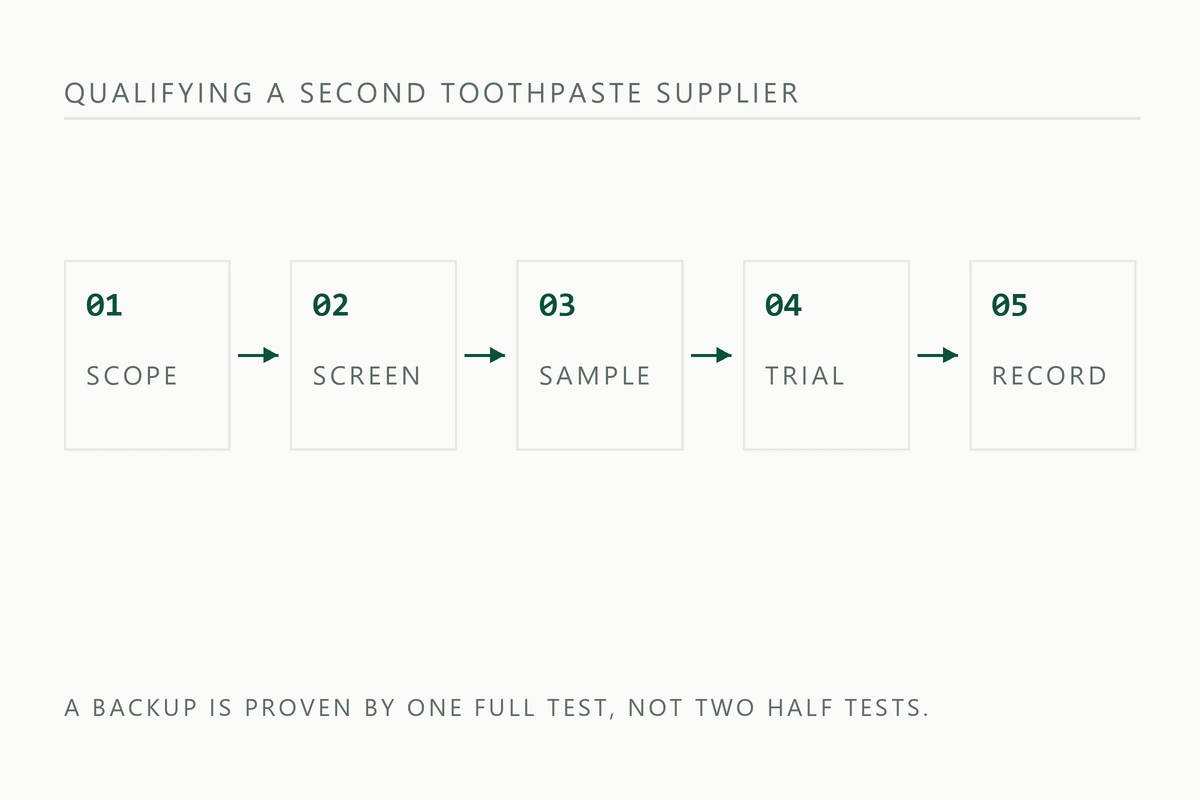
- Scope. Name what the backup must cover: one SKU, one pack format, one destination market. A source scoped as the whole range is too much to test and too vague to quote.
- Screen. A desk check on documents and capability questions before a sample is requested; the next section lists what it must settle, and the factory visit plan carries the same questions.
- Sample. The same written brief you sent the incumbent, compared against the retained reference rather than your memory of it; the approved sample versus production batch test applies the same discipline later.
- Trial. The first real order, at a size you actually buy. Until one exists the honest status is qualified and not ordered, which is more useful than a file that pretends otherwise.
- Record. Brief version, retained sample, documents with dates, who approved, and any condition on the approval. Without it the stage is a memory, and memories do not survive staff changes.
4. What the document screen has to settle
Screening is the cheapest stage and the most often skipped, because asking for documents feels like work before you have bought anything.
| What you request | What a complete answer settles | What it does not settle |
|---|---|---|
| The brief restated in their own words | That they read your specification and not a similar one | That their line can hold it |
| Ingredient declaration, and the level statement for any named component | That the paste is the same construction as the incumbent's | That the level is verified batch by batch |
| Pack specification: tube, cap, carton and the artwork file format | That the quotation covers the same components | That their print supplier can match it |
| The batch record fields, named rather than filled in | That a future batch can be compared with this one | That the first batch will conform |
"We can do that" counts only in a document you can file, and every request should name the format you expect back — an ingredient declaration, a pack drawing, a batch record with named fields. The quotation comparison method rests on the same basis.
5. Write the switch trigger before you approve anyone
Approval is not the end of the sequence. It is where you write down what would make you move: a qualified backup nobody has a reason to open gets read during a crisis.
- The condition. What event makes you switch: a delivery failure, a document that cannot be produced, a price that has left the market.
- The evidence. What you will look at on the day, and whether the sample and documents can still be found.
- The lead time. From decision to first delivery, which the backup's own quotation states and this page does not guess.
- The volume. In SKUs and units, so the first order is real rather than token.
- The owner. Who decides and who is informed; a trigger with two owners has none.
Requalification belongs on the same page. A sample approved long ago may no longer represent what the factory would make today, so name the interval and who reviews it; how long a qualification stays valid is a buyer's judgement. The reorder verification checks serve the same purpose once a supplier is live, and the first-order review turns one good trial into a pattern.
6. What to send the factory
A candidate can answer usefully only if the request is specific, so send the destination market, the SKU and pack size the backup would cover, the documents you will ask to see and the reference you will compare a sample against. If the range is still open, start from the NASHUDA toothpaste series or the Orbit & White toothpaste series, then send your requirements with the SKU you would test first, and we will confirm the specification, documents and pack. The factory sourcing process page sets out how an enquiry moves from brief to sample.