
A factory visit answers one question well: do the records your supplier describes exist where the toothpaste is actually made? It will not predict next month's batch, and it does not replace reading a specification. Plan five stages — brief, observe, trace, record, follow up — and decide what you want to see before you arrive, because a tour that opens with a slide deck rarely leaves you anything to file.
1. What a visit can prove, and what it cannot
A visit is a sample of one day. That is enough to see whether a batch record is opened at the filling line or typed up afterwards, whether the person answering your questions signs the release, and whether material that failed a check has somewhere to sit. Those are structural facts, hard to fake for a whole shift.
What a visit cannot do is confirm a claim or substitute for a certificate. A certificate has an issuer, a scope and an expiry date; a framed award is decoration. Ask for the document and read the scope.
2. Scope the visit before you book it
Name the SKUs you are considering, not "the factory". Tube and bottle filling are different lines, so ask which one runs while you are there: a stopped line shows equipment, a running line shows the changeover, the cleaning step and the record at the station.
Ask who attends. A visit with sales only is a meeting — request the production supervisor and whoever owns quality, and keep commercial talk for later. Send the document list a week ahead: a batch record for a named past order, calibration status for the weighing equipment, a changeover cleaning log, and your approved artwork revision. For a remote walkthrough, ask for a live, unedited call, a camera operator who can turn around, and a start at the line rather than in the meeting room. The RFQ checklist covers the commercial half.
3. Four areas to look at, and the record that should match
Each row pairs something you can see with a document you can request in the same hour. The last column is what should change your answer.
| Area | What to look at | Record to ask for on the spot | What changes your answer |
|---|---|---|---|
| Incoming material and storage | Lot labels, released versus held stock, storage conditions | Incoming inspection record and that lot's certificate of analysis | Unlabelled containers, or release stamps kept only in the office |
| Mixing and batching | Vessel identification, weighing step, transfer to filling | One completed batch record page: weights, equipment ID, operator, time | A template filled in later, or one record that could describe any product |
| Filling, sealing and coding | Component feed, seal check, the printed code | In-process check sheet and the line's code standard | A code printed but never recorded, or no retained sample of it |
| Cartoning and finished goods | Carton label and count, pallet build, hold area | Packing list, artwork revision, finished goods release note | Release with no link to a batch, or no separate hold area |
Photograph what you may and record what you were refused; the refusal is information.
4. Trace one batch from end to end
This part cannot be scripted. Choose a batch that has already shipped — ideally one you received — and ask for its record to be opened in front of you, not prepared beforehand.
Follow the chain aloud: material lot, batch number, filling date, carton code, shipping document. Each handover should carry a name and a date. Then ask for an entry that did not go to plan — a deviation, a rework, a rejected lot, a corrected code. How it was dispositioned, and who signed it, tells you more than a clean pass record.
If nobody at the line can find the record and one person carries out every document, write that down as an observation, not a delay. The traceability request lists the fields to ask for in writing.
5. Five stages, and what each one should leave behind
Each stage should leave something you can file; a visit that stops after stage two is a tour.
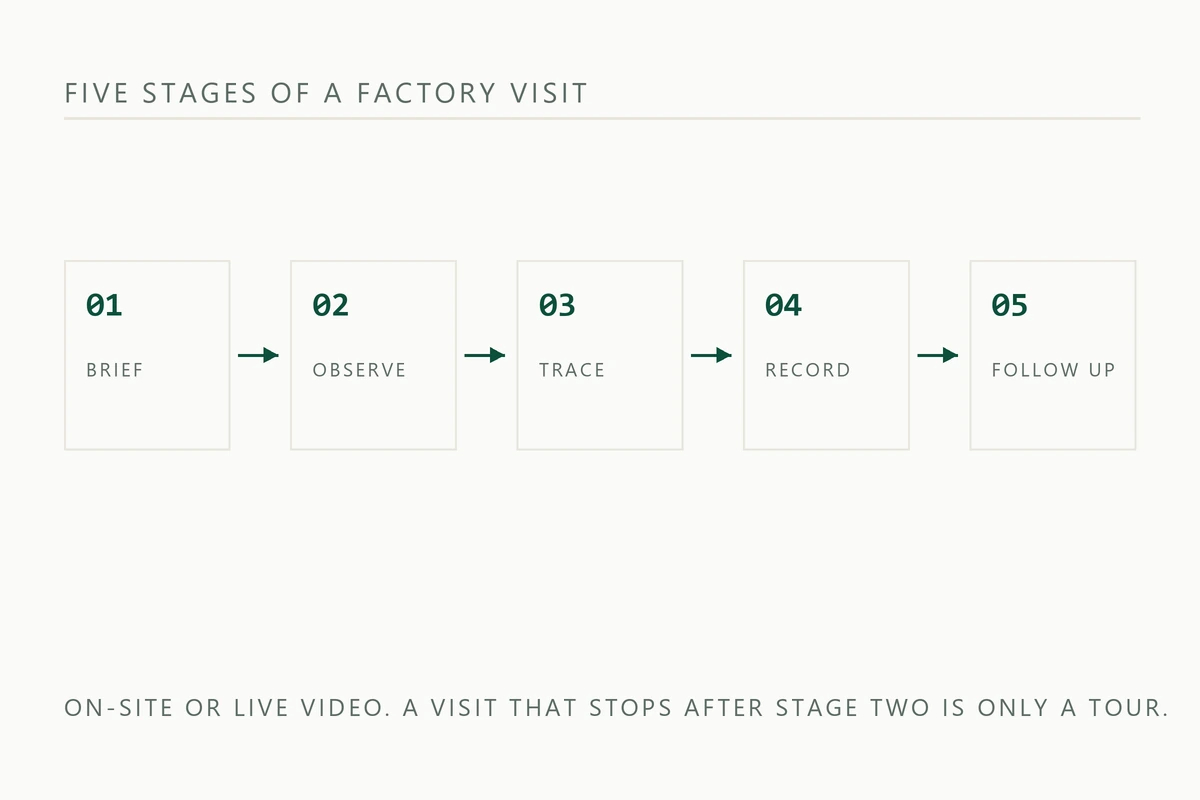
- Brief. A written agenda and document list, sent before you travel.
- Observe. The four areas above, with photographs only where permission was given.
- Trace. One batch walked end to end, with the gaps named as you find them.
- Record. A dated page: who attended, what was seen, what was asked for and not shown.
- Follow up. The promised documents in writing, each with an owner and a date.
6. Three outcomes, and where the gap list goes
Close the visit with one of three answers: proceed, proceed with conditions, or pause. Only the middle one needs care, because a condition that lives in an email thread does not survive a change of salesperson.
- Name the condition as a document — "the current batch record for SKU X, with revision and date", not "improve documentation".
- Give each condition an owner on both sides and a date by which it is answered.
- Put them into the purchase order or the specification annex, so they travel with the order.
If the visit confirms the process, the next check happens on the goods rather than the plant: the pre-shipment inspection covers that stage, and the first-order review turns what you saw into a score you can compare against the next supplier.
Send the destination market, the SKUs you want to see, whether you will visit in person or by live video, and the documents you want in advance. We will confirm which exist for the current batch and which still have to be produced — using the lines behind our NASHUDA tube range and our bottled range as the reference.
Send your visit plan to our team — market, SKUs and the records you want to see.