
A certificate of analysis states test results for samples drawn from one batch, measured against one specification. Its worth to a buyer is not that it exists but that it can be checked: the batch code on the paper is the code on the carton, every result sits beside the limit it was measured against, and the document names who ran the test. This guide sets out the fields that make it checkable, the order to read them in, and six failures that pass unnoticed.
1. A certificate describes a sample, not the shipment
A certificate answers one question: did the samples drawn from this batch meet the specification the factory released it against? It is a record of testing, not a certificate of free sale, a registration or a licence to sell anywhere, and letterhead does not change that.
It is also routinely filed as though it settled everything else. It cannot say what every tube weighs, whether a seal held through transit, or how a flavour reads after a hot crossing. Those come from the fill and seal records, from a pre-shipment check and from comparing the delivered batch with the sample you approved; our guides to shelf-life documentation, pre-shipment inspection and approved sample versus production batch cover them.
2. Five fields that make a certificate checkable
A certificate can run one page or five; length is not the test. These five fields are, because each closes a question the others leave open.
| Field | What it should say | What a missing version means |
|---|---|---|
| Batch or lot code | The code on the cartons and on the batch record, written identically on all three | Without one the paper cannot be attached to any goods; it is a template, not a record |
| Specification reference and revision | Which specification, at which revision, the batch was released against | A result cannot be read without it: one figure can pass one revision and fail another |
| Parameter, limit, result, method | One line per parameter with the limit, the measured result and the method used | A result with no limit is unreadable; a limit with no method is arguable |
| Sample and test date | When the sample was drawn and when it was tested | A test date earlier than the production date describes something else |
| Who tested and who released | The laboratory behind each method, and the named person, role and date of the release | An unsigned certificate has no owner; an unnamed laboratory cannot explain its method |
3. Five checks, in order
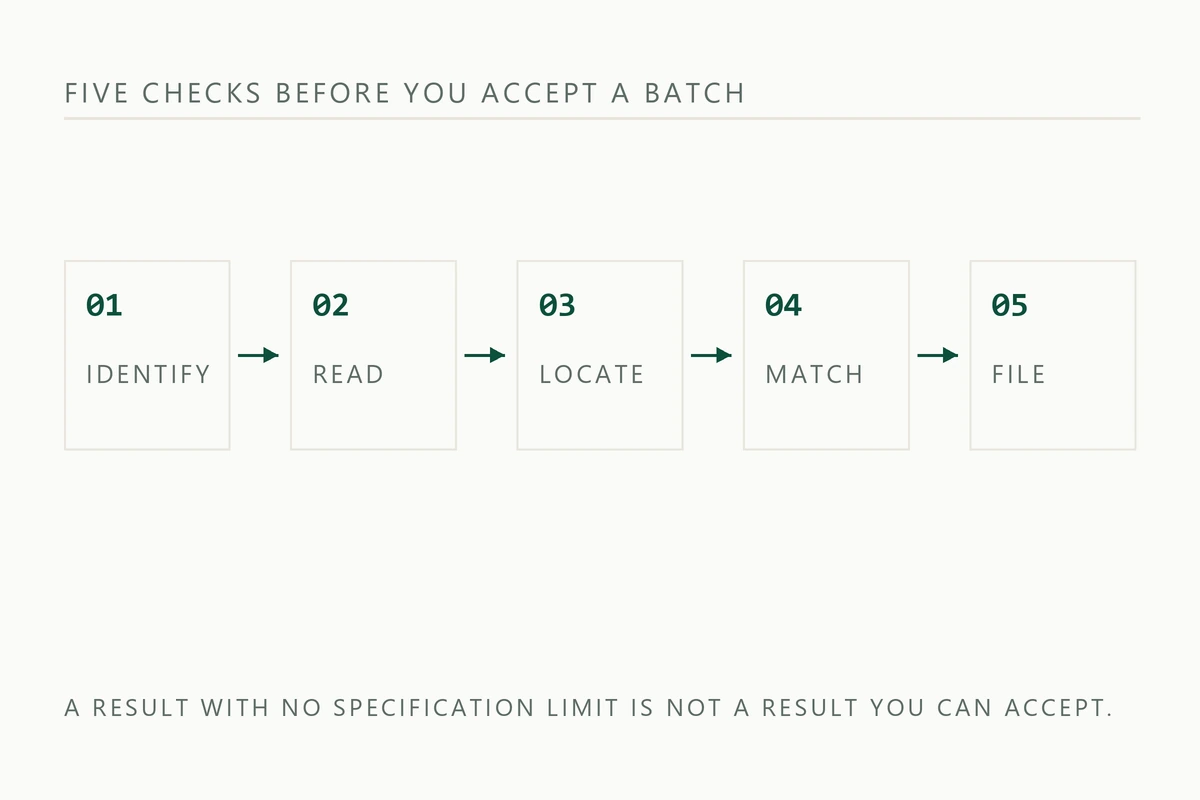
Read it in this order: a failure at 01 makes the rest worthless for this shipment.
- Identify. Pull a carton at random, read the lot code, and find that exact string on the certificate. If it is absent, stop: nothing further can be tied to these goods.
- Read. For each parameter read the limit, the result and the method as one line. "Conforms" with no value and no limit is a claim, not a result.
- Locate. Find who ran the test and when the sample was drawn; if the page does not say in-house or external, that is your next question.
- Match. Check product, variant, pack size and specification revision against your purchase order and its specification annex.
- File. Keep it with the batch record, packing list and purchase order under one lot code, so a later claim cites a document rather than a memory.
A result with no specification limit is not a result you can accept. That rule is check 02, and it is the one buyers skip when the document looks official.
4. Who ran the test changes what it proves
Two certificates can carry identical numbers and mean different things, depending on who did the work.
In-house results are part of the batch record and arrive quickly; ask which method was used, who signed, and whether the raw data stays with the batch. External results separate the person releasing the batch from the person measuring it; ask for the laboratory's own report rather than a summary retyped onto factory letterhead, because it is the transcription that gets forwarded to your customer.
Whichever applies, the certificate should say. A document that mixes both without marking them cannot be ranked against another supplier's.
5. Six quiet failures
None announce themselves at a glance:
- A pass or fail column with no values behind it.
- Two lot codes sharing an identical result sheet, down to the last digit.
- Results for the incoming material rather than the finished paste.
- A certificate for the neighbouring SKU: same paste, different flavour or pack size.
- A test date earlier than the production date it names.
- A specification with no revision number, so nobody can say which version the batch passed.
Each is a reason to ask, not to walk away: a supplier who explains it and sends the missing page tells you more than a clean certificate would. When the problem is not a missing page but two records that disagree — this certificate against the packing list, or a label against the release it was printed from — the order to settle them in is the document conflict resolution order.
6. What to send the factory
To receive a certificate you can use, send the destination market, the SKUs and pack sizes, the specification revision you are ordering against, and the parameters you want reported. Name the ones you will retest on arrival, so the same numbers are understood to be looked at twice.
Ask for it with the shipping documents, not after the goods land: one that arrives with the container can still hold a release, while one that arrives later can only describe a decision already taken. Our traceability request guide covers the batch records that sit beside it, and the RFQ checklist covers settling the specification it is measured against.
The question comes up first on a series with several variants, each tested against its own revision. Start from the NASHUDA toothpaste series or the nano-hydroxyapatite series, then send your requirements with the revision you are working from, and we will say which parameters a certificate can report and which need a separate record.