
A charcoal toothpaste proposal is easy to price and hard to verify. Two suppliers can send the same black tube, the same "bamboo charcoal" wording and the same shelf-ready photo, while the carbon inside differs in source, grade, particle size and the documentation that backs it up. This guide sets out the questions an overseas importer, distributor or private label brand should ask before accepting a charcoal toothpaste specification.
It is a purchasing framework, not a formulation recommendation. Use the fields below, and treat "not yet confirmed" as a valid entry rather than filling a gap with a number copied from another supplier.
1. Why paste colour is not a specification
Charcoal toothpaste is a look as much as a formula. A dark paste can come from activated carbon, from a small carbon content combined with other colouring, or from an appearance that is not carbon at all. The colour says nothing about what is dosed or what testing exists.
The American Dental Association's toothpaste overview describes the usual roles inside a dentifrice: active ingredients, abrasive agents that clean teeth and may physically remove surface stains, detergents, humectants, flavourings and thickeners. Carbon is not among the categories carrying an approved therapeutic claim there. That matters commercially, because a marketing claim and a tested function are not the same asset in an export file.
The FDA over-the-counter monograph for anticaries drug products defines a dentifrice as an abrasive-containing dosage form for delivering an anticaries drug to the teeth, and lists the fluoride compounds recognised for that purpose. Read it as a reminder that regulated claims attach to defined actives: ask your supplier which claims on the proposed pack sit inside a framework like that one, and which are cosmetic statements.
2. Ask what the carbon actually is
Carbon is a family of materials, not a single ingredient. Bamboo charcoal, wood-based activated carbon and coconut-shell carbon are different inputs with different paperwork. Ask the supplier to name the material, its source, its grade and the material-specification reference that will apply to your order.
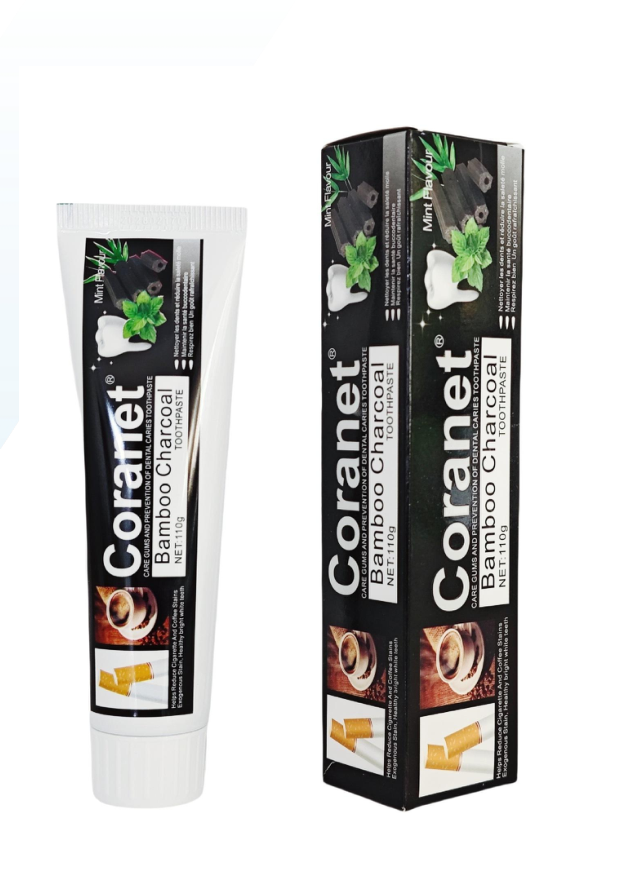
Browse our Bamboo Charcoal Mint Whitening series to identify the products we supply. A product name or photograph communicates intent; it does not confirm the carbon grade, the dosage or the artwork for your market.
3. Complete a carbon specification worksheet
Use one worksheet per proposed charcoal SKU, with a revision date. Every row is a question for the supplier; do not accept a cell filled from a comparable product rather than the candidate itself.
| Field | Question to the supplier | Evidence to attach |
|---|---|---|
| Material identity | Which carbon material is used, from which source, under which material reference? | Material specification sheet naming the input |
| Grade and form | Powder, granule or dispersion, and which grade designation applies to this order? | Supplier grade certificate or equivalent |
| Dosage | What content is proposed for the finished paste, in the specification's own units? | Formula or batch record reference |
| Particle size | Which size range and test method apply, and who measures it? | Test report with method and date |
| Abrasive system | Which abrasives are combined with the carbon, and how is total abrasivity controlled? | Formulation section and abrasivity test record |
| Contaminant control | Which heavy-metal and microbiological limits apply, to which specification? | Certificate of analysis for the batch |
| Colour source | Is the black appearance produced solely by the carbon content? | Declaration plus colourant list |
4. Handle abrasivity properly
Relative Dentin Abrasivity is the scale buyers cite when they worry about a charcoal paste. Ask whether a value exists for the exact proposed formula, which laboratory produced it, under which method and on what date. Then read it correctly: the ADA notes that RDA is used by industry, researchers and standards organisations for development and quality control, that it should not be used to rank the safety of dentifrices, and that values below 250 cannot be used quantitatively to rank safety.
Two consequences follow. A supplier quoting a single RDA number without a method, laboratory or report reference has not yet given you evidence. And an RDA number is not a whitening claim: it describes wear on dentin, not whether surface stains are removed.
5. Match the ingredient list to the claim
Charcoal products usually carry two claim families: cosmetic statements about appearance and freshness, and functional statements about stain removal, protection or sensitivity. For each proposed claim, ask which ingredient is responsible, what documentation supports it, and who reviewed the wording for your destination market.
Keep finished copy free of claims the file cannot support. Detox, antibacterial, enamel-safe, cavity protection and dentist recommended each need their own evidence trail. If the evidence is unavailable, change the copy.
6. Test batch consistency, not one sample
A single approved sample proves that one tube existed. Ask how carbon content, paste appearance and abrasivity are controlled from batch to batch, which parameter is measured in routine production, and what triggers a re-test. Request the batch record fields that will appear on your documents, so a delivered pallet can be matched to a production reference.
Our sample evaluation checklist covers documenting a sample against a written specification. For charcoal, add two comparisons: paste shade under the same lighting, and the declared carbon content against the delivered batch record. When two charcoal suppliers are in play, work through the charcoal supplier evaluation worksheet so both answers cover the same fields.
7. Compare two suppliers on one page
Comparing quotations works only when both cover the same fields. Record what each supplier actually answered, and mark unanswered rows in a way that survives the next meeting.
| Comparison field | Supplier A | Supplier B |
|---|---|---|
| Carbon material, source and grade reference | ||
| Declared content in the finished paste | ||
| Particle-size range and test method | ||
| Abrasivity record: value, method, laboratory, date | ||
| Heavy-metal and microbiological certificates for the batch | ||
| Claim list with the supporting document for each claim | ||
| Routine production checks and re-test triggers | ||
| Destination-market restrictions the supplier has identified | ||
| Open items the supplier still needs from the buyer |
Use our quotation comparison guide to keep price scope, packaging and delivery boundaries on the same basis as the technical rows above.
8. Confirm what travel and labelling require
Charcoal pastes are still toothpastes for logistics and paperwork. Ask which safety data sheet, ingredient declaration, certificate of origin or destination notification applies, who prepares it, and how long it takes. Confirm the languages and mandatory wording for the country of sale, and whether the black paste changes any handling or storage note on your documents.
Do not treat a generic certificate package as proof for a specific formula. Record the product or formula each document covers, its issuer, its date and its limits.
9. Next step
Send us your charcoal toothpaste brief with the destination market, the proposed SKU, the packaging direction and the open technical questions above. We will answer with the specification we can confirm, the documentation we can provide and the items that still need your decision. Send your charcoal toothpaste questions or review the wider factory sourcing process first.