
A consolidated shipment is one the factory does not load. Your cases are trucked to a forwarder's warehouse, stacked beside another supplier's goods, and loaded by a party that made neither product. Four records describe that cargo, written by different hands: the case mark and packing list at the factory, the pallet label and goods-received note at the consolidator. Nothing joins them unless you do.
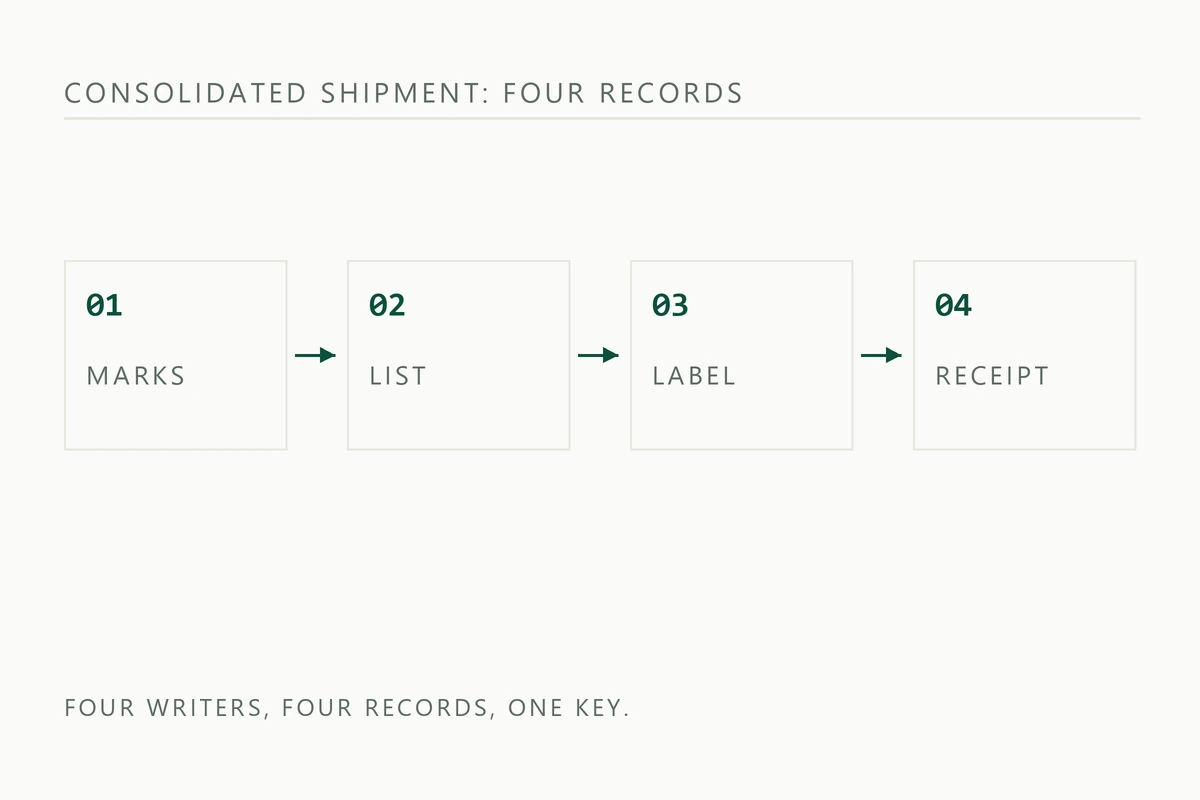
Consolidation splits the record, not the goods
The goods stay in their cartons; what changes is who can answer a question about them. At the factory one person walks to the pallet. At the warehouse your pallet stands beside another shipper's, and the only description of it is a label the warehouse printed.
So the join is built before the goods move, on one key: the carton mark sequence. If that range appears on the packing list, the pallet label and the receipt, a carton found at destination resolves backwards. If any of them omits it, the carton becomes unowned paperwork.
The case mark travels where no email follows
The case mark is printed by the factory and is the only record physically attached to the goods. Everything else is a file somebody can forward, mislay or retype.
Two consequences follow. The mark belongs in the purchase order, not the artwork proof, because a proof is approved weeks before a run and is not what the printer reads. And a mark cannot be revised at the warehouse: the cases are sealed, so the only remedy is a label applied over the printed one.
That remedy has a cost. An over-labelled case carries two identifiers, and a receiver who scans the applied one never sees the printed one. If you allow it, allow it in writing, name who may apply it, and say which identifier governs. The code convention itself is the two-supplier alignment question.
What the packing list has to enumerate
A list that gives a total per line item answers how much, not which. On a consolidated shipment the second question is the one that gets asked about a single carton.
So the list needs three things: the mark range covered by each line, the quantity per carton, and the product reference exactly as printed on the carton. A list reading four hundred cartons of one reference, with no mark range, joins to nothing.
How cases are built into a pallet is the mixed-SKU packing question; whether the pallet fits the container belongs to pallet and container planning.
A pallet label that carries two factories' cases
On a consolidated load a pallet can hold cases from more than one factory. It is where identity blurs: the label describes a pallet, and a pallet is not a product.
Two rules prevent it. Either the pallet is single-origin, carrying one factory's cases only, or the label enumerates by reference the packing lists it carries. A label giving a carton count and a weight, with no list reference, describes cargo nobody can trace; a number on no document exists only on the pallet, which gets re-wrapped.
The receipt is the only record that binds the consolidator
The goods-received note is the moment custody changes, and the one document a consolidator signs about your cargo. Specify what it must contain: the count against the packing list, the condition noted at receipt, the seal number, and whether each list arrived in full or in part.
Without that last item a shortage is unattributable. The factory's list says the cases left, the load plan says the pallet went on, and nobody has written that it arrived with fewer cases than the list described.
Ask for the note at the time of receipt; one issued a week later records a warehouse, not an event.
Run the join before the container closes
Four checks, once, on paper, while the goods are still reachable:
- Mark range on each packing list line against the marks printed on the cases.
- Packing list quantities against the pallet label's stated composition.
- Pallet label references against the goods-received note.
- All three against the booking: container, seal, and the pallet count declared.
| Record | Written by | Answers | Fails when |
|---|---|---|---|
| Case mark | Factory | Which carton is this | Printed outside the order |
| Packing list | Factory | How many, of what | Totals with no mark range |
| Pallet label | Consolidator | What sits on this pallet | Count and weight only |
| Receipt | Consolidator | What arrived, in what state | Issued days afterwards |
The fourth check is the one buyers skip: the booking is the only document stating how many pallets should exist. One pallet fewer on the receipt is a loading question the loader can still answer.
Three questions buyers ask
Can the factory print the forwarder's pallet label?
It can print to a format you supply, but the identifier belongs to the warehouse receiving the pallet. Two factories both printing pallet one produce two pallets with the same name.
Who is responsible when a pallet is short-landed?
Whichever signature is missing. The receipt fixes the count where custody changed; without it the shortage falls between dispatch and loading, and neither side will accept it.
Is a photograph of the pallet enough?
No. A photograph shows condition on one day and carries no signed count. Keep it as support for the receipt, never as a substitute.
What to send the factory and the forwarder
Send the factory the mark format and range, the packing list format with its mark range column, and the instruction that both match the purchase order. Send the forwarder the packing lists, the pallet label format, and what the receipt must record.
Then keep one copy of the four signed records together: the day you need them is the day neither party can reconstruct them. Start from the NASHUDA toothpaste series or the Orbit & White range, and send your requirements with the destination market and the shipping configuration.