
Two approved suppliers can make the same SKU, but only if they work from one reference set. Four points have to be identical at both sites: the artwork master, the code convention, the batch record form, and the comparison you run before either site ships. Qualification answered whether each factory could make the product; this page is about the file that keeps them making one.
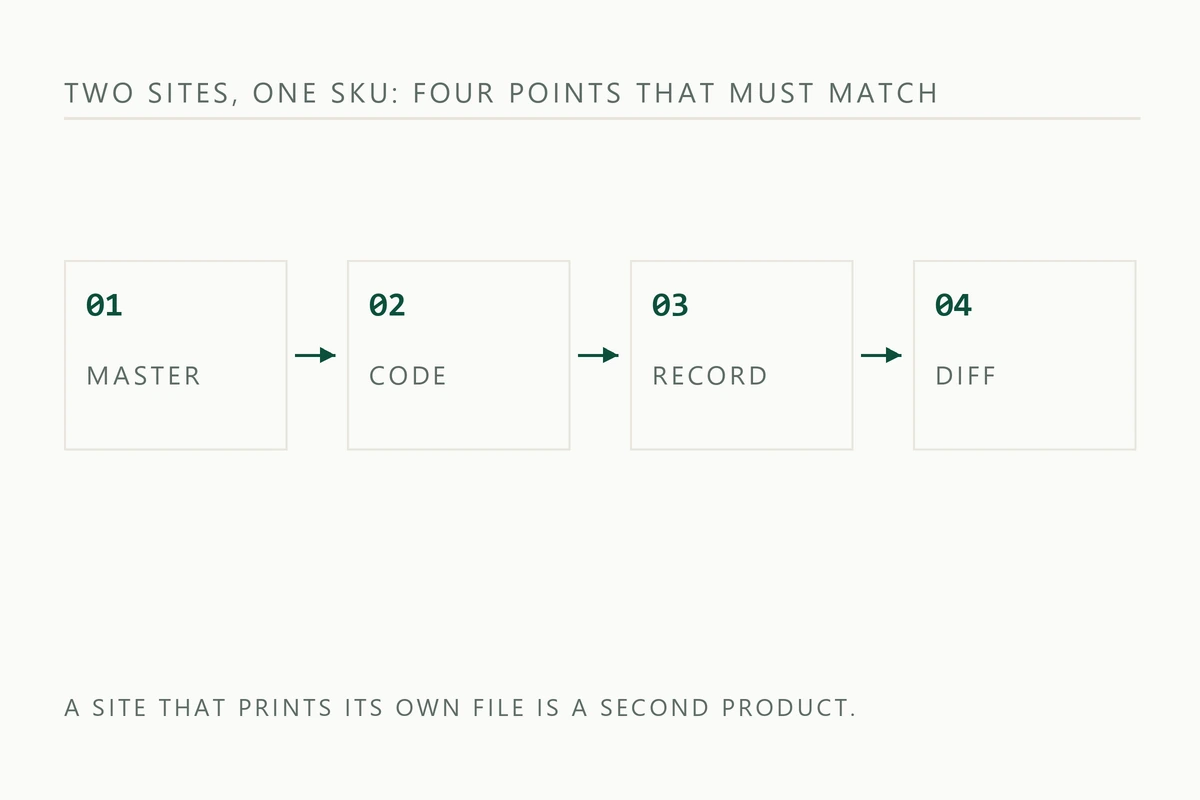
1. Approval is per site; the master is not
Artwork approval proves that one file was accepted at one printer. A second site receives the same artwork and separates it again, so the buyer now needs a master with a revision string and a named custodian, and a rule that both sites quote that revision on the order.
Two prepress departments given one PDF do not produce one plate. Separations, colour bars, trapping, bleed and the clear window for a batch code are rebuilt by whichever site prints. That is not a quality failure; it is what printing is.
The artwork approval checklist establishes one reference per component; a second site adds a custody question on top of the review. Name the file, the current revision, and who may change it. A site that cannot state which revision it is printing from is printing from memory.
2. One code convention, printed by both
A batch code identifies a run only if both sites read the same string the same way. Agree the fields and their order once — site, line, date, run — and require both sites to stamp to it, because the site field is the only part of the code that says which factory made the tube in your hand.
Left alone, each site numbers sensibly and differently. One puts the date first and the site letter last; the other reverses it. Neither can be sorted beside the other.
The collision to watch is between levels. If one site's carton code has the shape the other uses for a unit code, warehouse staff scanning a pallet get an answer that is true and useless.
What makes a code usable at all — length, contrast, position, survival through a carton — belongs to the batch code and traceability guide. The question here is narrower: the same fields, in the same order, at both sites.
3. The record both sites fill
Two sites will each fill their own QA template unless you issue one. Same fields, same order, same units, so a column from one site can sit beside the same column from the other without anyone translating it first.
The drift is boring and expensive. One site records a range where the other records a single value; one writes the date day-first, the other month-first; one names a parameter as the specification does, the other as the machine screen does.
None of it shows until you compare, months later, with a complaint open. Send a blank form to both sites before the first shared run: an empty form proves whether their system can produce the fields at all. Reading what comes back is the skill the certificate of analysis guide sets out.
4. Compare each site against the master
Before either site ships, compare one retail unit and one carton from each against the master. Comparing the two sites against each other only tells you they differ; comparing each against the master tells you which one moved.
Run it as a diff, not an audit: three checks per site, same day, against the revision string.
| Point | Compare | Against | If it differs |
|---|---|---|---|
| Master | A print proof, and the revision quoted on the order | The file you released | That site is printing something you never approved |
| Code | The stamp on a sampled unit and on a carton | The agreed field order | You cannot name the site from the goods |
| Record | A completed batch record, fields and units | The blank form you issued | The comparison you planned will not run |
Repeat it after any change at either site. A pass is a moment, not a state.
5. Where the file lives
One folder, one revision string, one owner. Both orders cite it, and a change approved at one site is not live at the other until it has been sent and acknowledged.
That clause is the whole risk. Change control is usually written for one factory and one buyer, so with two factories an approved change is half-applied by default. The change management routine already defines the version record; it needs a distribution step.
6. Three questions buyers ask
Can one site print cartons for the other?
Yes, and it is one of the cleaner ways to hold print identical, because only one prepress department is involved. It also makes carton delivery a dependency of the second site's run.
Does a second site need new packaging approval?
The site is approved separately; the design decision does not change. What needs confirming is that the new site prints the same revision — a one-line request and a common omission.
How often should the two sites be compared?
Before the first shared run, after any change to artwork, code or record, and whenever a site changes its printer. The interval is your call; the trigger list is what makes it happen.
7. What to send the factory
Send the destination market, the SKU and pack size both sites would make, the master revision you hold, the code field order you want and the blank record form. Name the site you expect to run first.
Start from the NASHUDA toothpaste series or the bottled series if the pack format is still open, then send your requirements with the SKU you would run at two sites. The factory sourcing process page shows how an enquiry moves from brief to sample.