
A shelf-ready case is a case the store puts on a shelf without unpacking it. That makes the case a fixture before it is a shipping unit, and it fixes six settings in the brief: shelf, facing, count, tear line, base and marks.
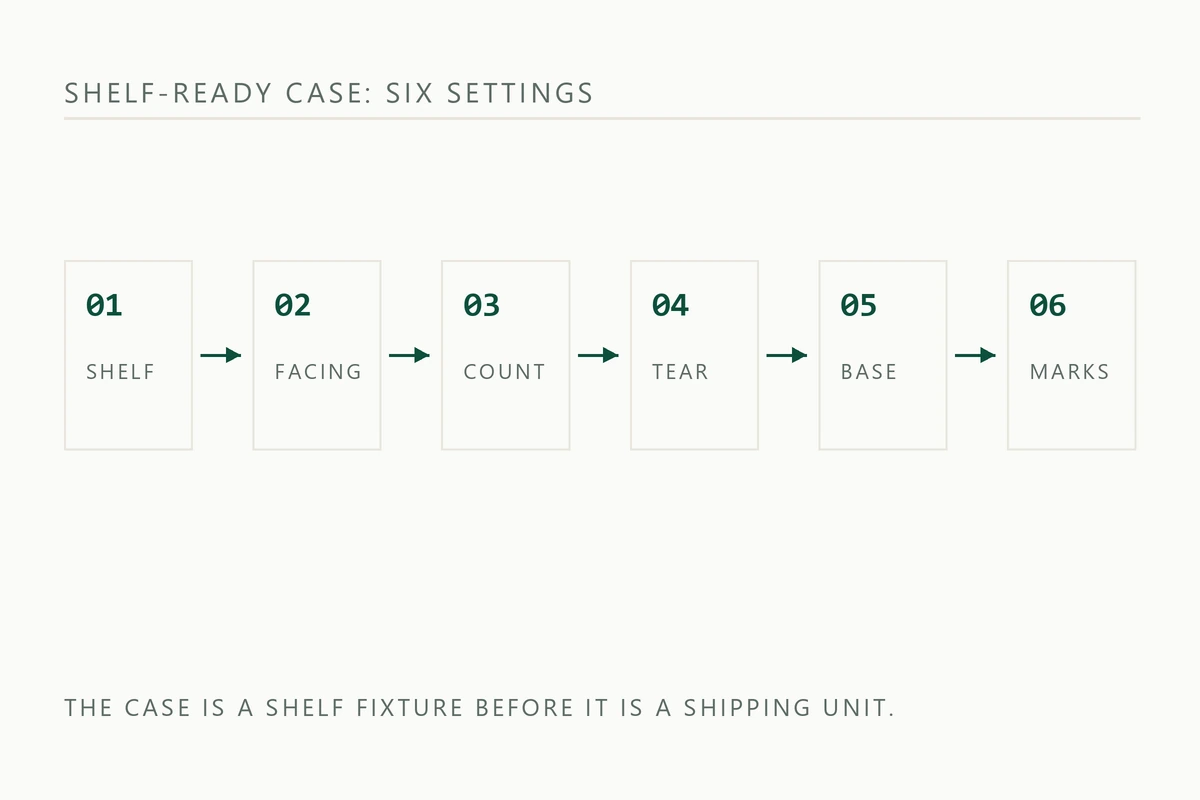
Start from the shelf, not the carton
The case has one physical job after delivery: sit in a bay and present the product. So the bay's figures come first — clearance above, usable depth, and whether the position is a shelf, a counter or a floor spot.
A planogram is the only document that states them. Without one, have the figures written into an email and keep it with the order.
The factory can build to a clearance you state; it cannot obtain the retailer's drawing or know whether one case fits another retailer's bay. A photo of a competitor's case is an appearance, not a clearance, and carton dimensions belong to the carton specification sheet.
What one facing carries
A facing is the unit the shopper meets at the shelf edge: one tube in its retail carton. Its width sets the blocking, which is how many facings stand side by side.
Most cases present one carton per facing with nothing in front. Where a case carries several products, the grouping changes the dividers.
The error to watch is orientation: a case built to the right count can still present the wrong panel, because the cartons were loaded with their backs out.
Facings and units in one number
Count is two numbers that have to reconcile: units per facing, multiplied by facings per case. Six facings of four and four facings of six both carry twenty-four units, and they are not the same case, so state the two numbers and never a total.
The count also decides which retailer the case suits: one sized for a large bay waits in the back room of a small store. How many sizes a range carries is the size ladder question.
| Setting | You decide | Factory needs | The failure |
|---|---|---|---|
| Shelf | Clearance, depth, position | Figures in writing | A guessed clearance |
| Facing | Which panel faces out | The front panel | Blank faces on the shelf |
| Count | Facings and units | Both, separately | A total hides the layout |
| Tear | Opening method and line | What the store uses | A ragged base |
| Base | Height and stability | The height to leave | Print facing the shopper |
| Marks | What must remain | The list on the proof | Batch code in the lid |
Where the store opens it
The tear line is the opening method, and it is a tooling decision: a perforation, a tear tape with a start tab, a die-cut lid, a removable top. A perforation across a printed panel can tear into that panel.
Two questions settle most of it. What will the store open the case with, and what happens to the part that comes off? A binned lid cannot be the only place a reorder barcode appears.
The line also has to be findable without the artwork, because guesswork produces a ragged base.
What stands up after the tear
The base is whatever remains standing on the shelf, and it has three requirements: it holds the units upright as they are taken out, it does not hide the product, and it looks deliberate.
Height is most of the argument. Too tall and the case masks the units in a low bay; too short and the front row falls forward. Stability as the last units leave is a question about the dividers.
Then read the base as a shopper would. Any print below the tear line becomes shelf furniture.
What has to survive opening
List the marks that must remain after opening, then check each against the tear line: product name, net content, batch code and date, market labels, base barcode.
The batch code is the one most often lost, because it is customarily printed on the panel that gets removed: fine for the warehouse, useless on a shelf.
Approving artwork and tear line as two documents is how a mark ends up in the removed portion. The artwork approval checklist covers the release; draw the line on the proof you release and keep it as the sample reference.
The assembled-shelf test
Build one case and test it as a store would:
- Stand it at the bay depth.
- Open it with what the store uses.
- Look from a shopper's eye line.
- Read every mark that must survive.
- Remove the front units and check the base.
- Try to close it again, if a store might.
Six checks, one case, findings you can send back as a list; a case that fails the base is a case with a perforated lid.
Three questions buyers ask
Is a shelf-ready case the same as a display unit?
No. A display unit is a fixture the store keeps. A shelf-ready case is a shipper the store opens and leaves on a shelf.
Can one case both ship and shelve?
Yes, and that is the point of the format. The cost is protection: the face visible on the shelf is also the face that travels.
Who supplies the fixture figures?
The retailer, or your merchandising team. A supplier offering to make a case shelf-ready without asking for height and depth is describing a look, not a fit.
What to send the factory
Send the destination market, the SKU and pack size, the clearance above, the usable depth, the count as facings multiplied by units, the opening method, and the marks that must remain.
Name the retailer or channel the case is built for; if two are in scope, say so now, because one case rarely fits both. Start from the NASHUDA toothpaste series or the kids series, then send your requirements with the fixture figures you hold.