
Two catalogues arrive in the same week. One offers a dozen SKUs across several flavours; the other offers four in a single size. Side by side they look comparable, and that is the trap. A toothpaste series is not a list of products: it is five layers of decisions, and two suppliers rarely document the same layer to the same depth. Put both on one sheet, in the order the layers constrain each other, and the choice becomes a comparison.
1. A series is five layers, not a list of SKUs
Read any series page, including ours, and you are looking at five layers in a fixed order:
- Paste specification. What the product is declared to be, in a document with a revision and a date.
- Format. Tube or bottle, and the component the series is built on — a filling decision, not a photo choice.
- Size set. Each fill offered in that format, with its declared net content.
- Variant set. The flavours and colours, and the sizes each one is actually offered in.
- Claim and document set. The wording allowed on the pack, and the file behind it.
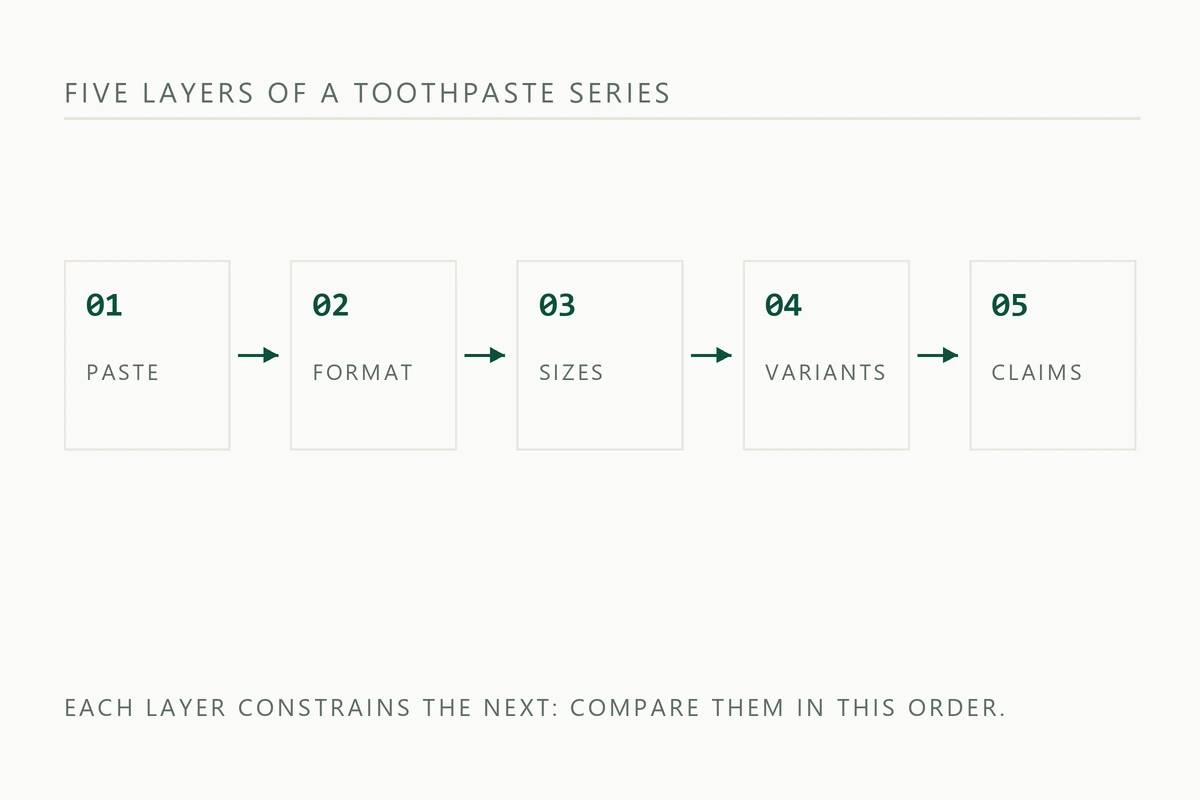
The order is not cosmetic. Change the format and the size set is rebuilt from the component's capacity rather than carried across; that reopens the variant set, and a variant change reopens the artwork and every claim printed on it. Opening with the claim — which promise sounds stronger — is therefore the hardest comparison to finish.
2. Fix the unit before you compare anything
Most catalogue comparisons fail on arithmetic, not judgement.
- Variants counted as SKUs. One size in six flavours is six SKUs; three sizes in two flavours is also six. Same number, different offers.
- Catalogue versus orderable. A series may list variants that need new artwork before they ship under your label. Ask which run against your approved revision.
- Series fields scored at SKU level. Paste specification and claim set belong to the series; net content and carton count belong to the SKU.
Then fix one rule: a blank is a question, not a zero. Send it in writing, record the answer with a date, and if it returns blank the layer scores as undeclared.
3. What to record for each layer
One row per layer, the same four columns for both candidates. The last column is the one buyers skip, and it decides whether the sheet can be trusted.
| Layer | Record | Ask for it as | A blank means |
|---|---|---|---|
| Paste specification | The revision identifier and date of the sheet, plus the fields it declares | The specification sheet with revision and date | You have a brochure, not a specification |
| Format | Tube or bottle, and the component reference the series is built on | The component name for the SKU you are quoting | The format is implied by a photograph |
| Size set | Each fill with its declared net content | The label copy or the specification annex | The size exists only in a mock-up |
| Variant set | Each flavour and colour, and its sizes | The SKU matrix, size against variant | Planned rather than run; confirm against the current batch record |
| Claim and document set | Pack wording permitted for your market, and the document behind each wording | Label copy plus one claim file line per claim | The adjective has no document behind it |
4. Names are not specifications
The adjectives in a series name — whitening, bright, fresh, probiotic, charcoal — are the least comparable thing about it. Two ranges can both be sold as whitening and permit different wording on the pack in your market, because the permitted wording depends on that market's rules and on the evidence available for that variant. Comparing adjectives produces a preference; comparing the claim list and its documents produces a decision.
Ask for the wording, not the category, and in the language you will print. If it cannot be supported for the variant you chose, keep the sensory description and drop the claim.
5. Score after the sheet, not before
Fix three to five criteria and their weights before you open either catalogue, then rate each series only against what the sheet records: undeclared scores nothing, a declaration scores partially, a declaration with a document scores fully. Weighting done after reading the catalogues is a justification, not a comparison. When two candidates finish close, the tie-break is a sample rather than another meeting: request the same variant and size from both and compare them under the conditions in our guide to approved sample versus production batch.
6. Put the sheet into the RFQ
Send the one-page sheet with your RFQ: both series names, the market you will sell into, the five layers as columns, and the instruction that every answer carries a revision and a date. A quotation built on the same five layers can be compared line by line; one built on a catalogue cannot. If the sheet exposes a gap you cannot close from the desk, the factory visit checklist turns it into something to see at the line.
Send the two series you are weighing, your destination market and the layers you care about most. We will answer the same five for our own ranges — including the fields we cannot fill yet — using Orbit & White and our bottled series as the two references.
Send your series comparison to our team — market, series names and the layers you need answered.