
Most ranges grow by addition: a tube for a new flavour, another for a smaller size, a third because one customer asked. Subtraction is the decision nobody schedules, so the range keeps every product that has ever sold once, and its shelf space comes out of the products that still earn it.
After the first sell-through, the evidence a range review needs is already in your reports. This guide covers the subtraction side: how to measure a SKU on one basis, rank it against the rest, and settle what dropping or replacing one leaves behind.
1. Sell-through needs a denominator
Units sold is the number buyers see first and the least useful on its own. A product listed in every store will out-sell the same product listed in a handful, and the difference is distribution rather than demand.
Three denominators do most of the work. Units per store per week shows what a listing is doing on the shelf. Share of the range's units shows what the product costs the rest of the portfolio in space and stock. Stock cover shows whether a slow seller is still only a shelf problem or has become a cash problem.
Two rules keep the comparison honest: one period for every SKU, because a promotion month flatters whichever product was promoted; and one channel, because a SKU slow in pharmacies and quick in discount retail is a channel problem before it is a product problem.
2. Four fields, one ranking
Four fields are enough to rank a range, and each answers a different question:
| Field | What to record | What it decides |
|---|---|---|
| Sell-through rate | Units per store per week, one period, one channel | Whether the product is moving at all |
| Share of range units | The SKU's units against the range total | What it costs the other products |
| Stock cover | Weeks of stock at the rate it is selling | Whether a slow seller is a cash decision |
| Substitute | The SKU that would take the volume, by name | Whether dropping it leaves a gap |
A blank field is not a zero. If the retailer never reported sell-through, write "not reported" and treat the SKU as unranked rather than last: a product that was never measured should not be dropped on a number it never had.
3. Five steps from measurement to a decision
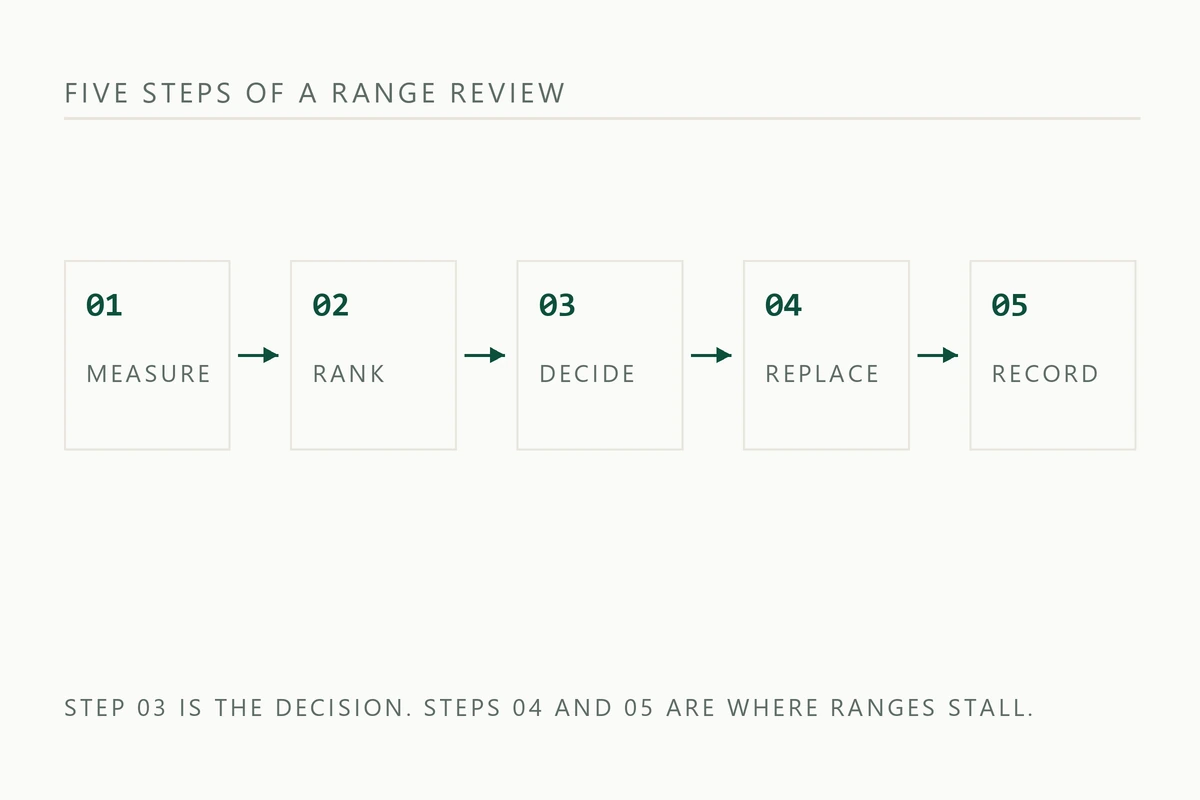
Each step leaves one file behind:
- Measure. Fix the denominator first: one period, one channel, units per store per week. Record where the figure came from and what period it covers.
- Rank. Order the range on the sheet, keeping the raw numbers beside the ranking. A rank hides whether the gap between two products is small or a category of its own.
- Decide. Give every SKU one of three outcomes — keep, hold or drop — and write the test that produced it. Hold means a stated condition and a review date, not "wait and see".
- Replace. Name the product that takes the space before the old one comes out. An empty facing is filled by whoever asks next.
- Record. Put the decision, the reason and the date into the range file that quotations and artwork revisions are built from.
Step 03 is the decision. Steps 04 and 05 are where ranges stall: the numbers are agreed, and the replacement waits for a meeting that keeps being postponed.
4. Dropping a SKU leaves four things behind
A product is not only a tube. Four items belong in the same decision:
| What is left | What has to be settled | Where it goes wrong |
|---|---|---|
| Leftover stock | The route for units still in your warehouse and in the channel: sell through, transfer or write off | Deciding the intention instead of the route |
| Artwork and barcode | The print files, barcode and carton marks tied to that SKU, parked as retired with the last revision produced | Files reused later for a different product |
| The order line | The line in the range file your supplier quotes from, removed in the same step | A reorder quoted against a product you dropped |
| The shelf gap | The facing the product held, assigned in the same decision | A gap filled after the reset, by default |
The order line is the one that gets forgotten: a supplier quoting from last season's range file keeps the dropped SKU in the offer, and a buyer working from that offer can order it again by accident.
5. Replacing without reopening the artwork
The cheapest replacement keeps the packaging and changes what is inside it: a new flavour or paste in the same tube diameter, cap and retail carton size reuses the size ladder you already approved. Change the tube size or the carton and you reopen the artwork, the barcode, the carton marks and the pallet arithmetic — a new SKU in everything but name.
Inside the same series, treat the replacement as a change rather than an addition: the artwork revision, the approved sample and the batch record all have to state which version is in production. Our guide to private label change control covers the notice and version fields; the size ladder shows what each size has to earn.
6. What to send the factory
Three documents make a range review usable on the supply side: the current range file with SKU names and pack sizes, the artwork revision in force for each one, and the decision list with dates. With those, a quotation can be built against the range you run rather than last season's catalogue.
Send us the range file, the pack sizes and the decisions you have taken, and we will confirm which series pages they map to and what the current batch record says for each. Start from the Orbit & White series or the Diro & White fruit series.
Send your range review to our team — market, SKU list, and which products are being dropped, replaced or kept.